Every autumn, Edmonton contractors face the same problem: a heating system that needs a boiler panel yesterday, and a supply chain that did not get the memo. Temperatures in Alberta, AB can drop below minus twenty before November ends, and once the cold sets in, lead times stretch, installation crews book solid, and the pre-built boiler panels that were sitting on shelves in September are long gone. Getting ahead of that rush is not complicated, but it does require a plan.
- Why Pre-Built Panels Make Sense for Edmonton Projects
- What a Pre-Built Boiler Panel Actually Includes
- Timing Your Order Before the Winter Rush
- How to Spec the Right Panel for Your System
- When a Custom Panel Is the Better Call
- Get Your Boiler Panel Order in Now
- Frequently Asked Questions
Why Pre-Built Panels Make Sense for Edmonton Projects
Edmonton’s commercial and multi-residential construction market moves quickly, and project timelines rarely leave room for fabrication delays. Pre-built boiler panels are assembled, pressure-tested, and ready to drop into a mechanical room, which cuts on-site labour hours significantly compared to field-built alternatives. For a city where the heating season is long and unforgiving, that speed matters.
Pre-built panels also deliver consistent quality. Because each unit is built in a controlled shop environment, the pipework, valves, and controls meet the same standard every time. There is less variability than when multiple trades assemble components on a busy job site, and that consistency translates directly into fewer callbacks and easier commissioning. If you want to understand the broader context of how these panels fit into a building’s system, our post on boiler boards in Edmonton covers the fundamentals well.
For Alberta projects, pressure equipment is regulated by ABSA under the Safety Codes Act, and having a factory-assembled panel with documented pressure testing also simplifies the inspection process. Inspectors can review a clear bill of materials rather than piecing together a field-built assembly after the fact.
What a Pre-Built Boiler Panel Actually Includes
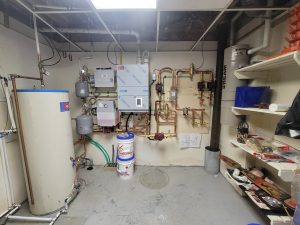
A boiler panel is the centralized control and distribution assembly that connects the boiler to the rest of a hydronic heating system. At minimum, a standard pre-built unit for a commercial application will include a supply and return header, isolation valves, a system pump or pump connections, an expansion tank connection point, a pressure relief valve, fill and drain valves, and basic instrumentation like pressure gauges and thermometers.
More fully specified panels add variable-speed pump drives, mixing valves, motorized zone valves, and a controls interface that ties into a building automation system. The configuration depends on whether the project is a simple two-pipe system or a more complex primary-secondary or low-temperature radiant setup. Knowing your system type before you call is the fastest way to get an accurate quote.
We also offer pre-built pump boards as standalone assemblies when a project needs pump distribution separate from the main boiler assembly. These pair cleanly with a panel or work independently depending on system layout.
Timing Your Order Before the Winter Rush
The window that most Edmonton contractors miss is summer. August and early September are the ideal months to place an order for a panel needed in October or November. By the time Thanksgiving weekend passes, fabrication queues at every reputable shop in Western Canada have filled up, component suppliers are back-ordered on circulator pumps and expansion tanks, and everyone is competing for the same installation crews.
Standard lead times for a pre-built boiler panel range from two to six weeks depending on complexity and current shop volume. Add shipping time for Alberta, AB deliveries if the fabricator is not local, and a six-week lead time ordered in late October means the panel may not arrive until mid-December. Ordering in August or September builds in a comfortable buffer and keeps your project on schedule.
If you are managing a portfolio of properties, staggering your orders rather than placing them all at once also helps. It spreads the installation workload and reduces the risk that one delayed shipment holds up multiple sites at the same time. Talk to us early and we can help you sequence orders across a season.
How to Spec the Right Panel for Your System
Specifying a boiler panel correctly comes down to four variables: the total heating load in BTU/hr, the design flow rate in gallons per minute, the supply and return water temperatures, and the number of zones or circuits the panel needs to serve. Get those four numbers from your mechanical engineer or existing system documentation before you request a quote. A panel built to the wrong flow rate will never perform correctly, regardless of how well it is installed.
Piping connection sizes matter too. Confirm the boiler’s supply and return flange sizes and the header outlet sizes your distribution system expects. Mismatched connections on site add cost and delay. We ask for this information upfront so the panel arrives ready to connect without field modifications.
Controls compatibility is the third consideration. If your building uses a specific BAS platform, confirm that the panel’s controls package can communicate with it. We can configure panels with BACnet, Modbus, or other standard protocols depending on what your controls contractor needs. For projects that compare options across cities, our overview of boiler panels in Vancouver outlines similar specification considerations in a different market context.
When a Custom Panel Is the Better Call
Pre-built panels work well for a wide range of commercial and multi-residential applications, but they are not the right answer for every project. If your mechanical room has unusual spatial constraints, if the system requires a non-standard configuration, or if the project engineer has specified components that fall outside a standard build, a custom boiler panel is worth the extra lead time.
Custom panels are also common in retrofit situations where an existing boiler room has fixed pipe locations that a standard panel cannot match without excessive field modification. In those cases, the cost of modifying a pre-built unit often exceeds the cost of building one to the exact dimensions required. Our post on custom boiler panels in Edmonton walks through the scenarios where a custom build is the practical choice.
The lead time for a custom panel is longer, typically six to ten weeks for a complex assembly, which reinforces the case for early planning regardless of which route you choose. If you are deciding between pre-built and custom now, contact us with your project details and we can give you a straightforward recommendation based on your specs and timeline.
Get Your Boiler Panel Order in Now
If your Edmonton project has a heating system startup date between October and January, the time to order your boiler panel is now, not when the first cold snap hits. Evolve Hydronics supplies pre-built boiler panels to contractors and mechanical firms across Alberta, AB, and we work with you on specifications, scheduling, and delivery to make sure your project stays on track. Reach out through our Edmonton service page or contact us directly to discuss your order. We are also available to support projects in Calgary through our hydronic heating service in Calgary, and we keep inventory moving across Western Canada year-round.
Frequently Asked Questions
How long does it take to receive a pre-built boiler panel in Edmonton?
Standard lead times run two to six weeks from order confirmation, depending on panel complexity and current shop volume. Simpler single-zone panels trend toward the shorter end. More fully specified units with variable-speed drives and BAS integration take longer. Shipping within Alberta, AB adds a day or two on top of fabrication time, so plan accordingly and order early.
What information do I need to provide when ordering a boiler panel?
You need four key figures: total heating load in BTU/hr, design flow rate in GPM, supply and return water temperatures, and the number of zones or circuits the panel will serve. Piping connection sizes and your BAS or controls platform are also important. Having these ready when you call shortens the quoting process considerably and reduces the chance of a costly specification error.
Are pre-built boiler panels code-compliant for Alberta installations?
Yes, panels built to Alberta, AB Safety Codes Act requirements are code-compliant for installation in Edmonton and across the province. Our panels are pressure-tested in the shop and documented with a clear bill of materials, which supports the safety codes inspection process. Always confirm with your local authority having jurisdiction if your project has specific permit conditions.
Can a pre-built panel work with my existing boiler?
In most cases, yes. Pre-built boiler panels are designed to interface with a wide range of commercial boiler brands and models. The key is matching the connection sizes and flow rates to your boiler’s specifications. If your boiler has unusual flange sizes or a non-standard piping arrangement, a custom panel may be a better fit. Share your boiler model and mechanical drawings with us and we will confirm compatibility before you order.
What is the difference between a pre-built boiler panel and a custom boiler panel?
A pre-built panel is assembled from standard configurations that cover the majority of commercial applications, and it is ready to ship faster and typically at a lower cost. A custom panel is engineered and fabricated to a specific project’s exact dimensions, component list, and spatial requirements. Custom panels suit retrofit projects with fixed pipe locations, non-standard system designs, or engineer-specified components that fall outside standard builds. Our post on custom boiler panels in Edmonton goes deeper on when to choose each option.
Do you supply boiler panels for residential projects or only commercial ones?
We primarily serve commercial, institutional, and multi-residential projects where panel assemblies are the standard approach. Single-family residential systems are generally too small to require a dedicated boiler panel assembly. If you are unsure whether your project qualifies, contact us with a brief description and we can point you in the right direction quickly.