
Winnipeg regularly records some of the coldest temperatures of any major city in Canada, with winter lows that can reach minus 40 degrees Celsius. When your building depends on a hydronic heating system, the boiler panel sitting at the heart of that system is not a secondary concern. Choose the wrong one, and you risk pressure failures, zoning errors, and a cold building during the worst possible week of the year. This guide breaks down exactly what to look for.
- Why Hydronic Heating Suits Winnipeg’s Climate
- What a Boiler Panel Actually Does
- Pre-Built vs. Custom Boiler Panels for Extreme Cold
- Key Specs to Review Before You Buy
- Hydronic Heating Winnipeg Installation Considerations
- Frequently Asked Questions
Why Hydronic Heating Suits Winnipeg’s Climate
Water carries heat far more efficiently than air, which makes hydronic heating a natural fit for a climate where buildings need sustained, high-output warmth for months at a time. Instead of blowing dry, forced air through ducts, a hydronic system circulates hot water through a network of radiant panels, baseboards, or in-floor tubing. The result is steady, even heat that does not spike and dip the way forced-air systems tend to do.
For commercial and multi-unit residential buildings in Winnipeg, Manitoba, that consistency matters enormously. Occupants are more comfortable, and the system runs more efficiently because it does not need to constantly recover from large temperature swings. In a climate where heating season can last six months or more, those efficiency gains add up to real savings on fuel and maintenance costs.
Hydronic systems also scale well. A small boiler panel can serve a single zone in a residential property, while a larger engineered panel can manage dozens of independent zones across a commercial building. That flexibility is one reason hydronic heating remains the preferred choice for contractors and mechanical engineers working on Winnipeg projects of every size.
What a Boiler Panel Actually Does
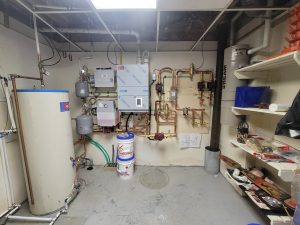
A boiler panel is the control and distribution hub of a hydronic heating system. It houses the pumps, mixing valves, manifolds, sensors, and controls that manage how heat moves from the boiler to each zone in the building. Without a properly configured panel, even the most powerful boiler cannot deliver heat where it needs to go, at the right temperature and pressure.
Think of the panel as the nervous system of your heating setup. It reads supply and return temperatures, adjusts pump speeds, and responds to zone calls so that each area of the building gets exactly what it needs. In a Winnipeg winter, when outdoor temperatures can drop dramatically within hours, that responsiveness is what keeps occupants comfortable and prevents the system from working harder than necessary.
Panels also protect the boiler itself. Mixing valves prevent cold return water from shocking a hot heat exchanger, which is a common cause of premature boiler failure in northern climates. A well-designed panel extends equipment life and reduces the frequency of service calls. For guidance on what that looks like in a commercial context, the post on boiler boards in Winnipeg for commercial hydronic systems covers the topic in practical detail.
Pre-Built vs. Custom Boiler Panels for Extreme Cold
The decision between a pre-built and a custom boiler panel comes down to your project’s complexity, timeline, and performance requirements. Pre-built boiler panels are factory-assembled, tested, and ready to install. They are an excellent choice when the system layout is straightforward, zone counts are moderate, and the schedule is tight. Because the assembly and testing happen off-site, installation time on the job is significantly shorter.
Custom boiler panels are designed and built to match a specific system. They make sense when zone counts are high, when the building has unusual load requirements, or when multiple boilers need to be staged together. A large Winnipeg apartment building or commercial facility with complex zoning will almost always benefit from a custom panel because the controls and components can be specified to match actual demand rather than a standard template.
For extreme cold climates, one consideration that often pushes projects toward custom work is redundancy. A panel designed with backup pump circuits and failover controls can keep the system running even if a component fails at minus 35. That kind of resilience is harder to achieve with a standard pre-built unit. Discuss your outdoor design temperature and your building’s heat loss calculations with your mechanical engineer before committing to either path.
Key Specs to Review Before You Buy
Regardless of whether you choose a pre-built or custom panel, certain specifications directly affect performance in a cold climate. Review each of these before placing an order or approving a design.
- Maximum working pressure: Panels rated for higher pressures give you more flexibility in taller buildings and multi-story systems.
- Supply water temperature range: Confirm the panel can handle the high supply temperatures needed during deep cold snaps, typically up to 180 degrees Fahrenheit for baseboard systems.
- Pump sizing: Undersized pumps cannot maintain adequate flow when the system is under full load. Ask for the flow rate and head pressure curves.
- Number of zones: Each zone needs its own control circuit. Make sure the panel matches your current zone count with room to add more.
- Mixing valve type: Thermostatic mixing valves protect both the boiler and low-temperature zones like in-floor radiant from receiving water that is too hot or too cold.
- Control compatibility: The panel controls must be compatible with your building automation system or thermostat setup.
If your project involves pre-built pump boards as part of a larger system, verify that the pump board specifications align with the boiler panel’s flow requirements. Mismatched components are a common source of commissioning problems that are far easier to catch on paper than on the job site.
Hydronic Heating Winnipeg Installation Considerations
Installing a hydronic heating system in Winnipeg involves a few practical realities that do not apply in milder markets. Manitoba’s building code requires that mechanical systems meet specific standards for freeze protection, and any outdoor or semi-conditioned mechanical room needs to be designed so the panel itself never drops below its rated operating temperature.
Glycol concentration is one of the first conversations to have on any Winnipeg project. Most residential and commercial systems in this climate use a propylene glycol and water mixture calibrated to protect against freezing well below the local design temperature. The panel’s pumps, valves, and seals all need to be compatible with glycol solutions, so confirm this before specifying components.
Pipe insulation in mechanical rooms and wherever piping passes through unconditioned space is also critical. Heat loss from uninsulated supply lines reduces system efficiency and can cause localized freezing in extreme weather. Work with a licensed mechanical contractor who understands Manitoba’s climate conditions and local code requirements. If you want to see how similar decisions play out in other cold-climate markets, the post on hydronic heating in Calgary covers comparable Alberta considerations.
Finally, plan your commissioning schedule around the heating season. Systems commissioned during summer may behave differently once outdoor temperatures drop. A full-load test during cold weather is the only reliable way to confirm the panel is performing as designed.
Ready to specify the right boiler panel for your Winnipeg project? The team at Evolve Hydronics builds and supplies both pre-built and custom panels designed for exactly this kind of climate. Visit our Winnipeg hydronic heating page or browse our custom boiler panels to start the conversation. We can help you match the right panel to your load calculations, zone count, and installation timeline before you break ground.
Frequently Asked Questions
How cold does Winnipeg get, and does that affect boiler panel selection?
Yes, significantly. Winnipeg, Manitoba regularly sees lows of minus 35 to minus 40 degrees Celsius, placing it among the coldest major cities in Canada. That outdoor design temperature drives boiler sizing, glycol concentration, and the redundancy features you should specify in a boiler panel. A panel built for a milder climate may not have the pump capacity, mixing valve range, or failover controls needed to maintain performance during extended deep-cold periods.
What is the difference between a pre-built and a custom boiler panel?
A pre-built panel is factory-assembled and tested to a standard configuration, making it faster to install and well-suited to projects with straightforward zone counts and load requirements. A custom panel is designed and built to match a specific system, which is the better choice for buildings with high zone counts, unusual load profiles, or multiple staged boilers. Both options are available through Evolve Hydronics, and the right choice depends on your project’s complexity and schedule.
Do hydronic heating systems in Winnipeg need glycol?
Yes, in most cases. Any portion of a hydronic system that could be exposed to temperatures below freezing, including piping in mechanical rooms that are not fully conditioned, should be protected with a propylene glycol and water mixture. The glycol concentration needs to be calculated against the local design temperature, which in Winnipeg means protecting well below minus 35 degrees Celsius. All components in the panel, including pumps, valves, and seals, must be rated for glycol service.
How many zones can a single boiler panel handle?
It depends on the panel design. Pre-built panels typically support a defined number of zones, often ranging from two to eight for residential and light commercial applications. Custom panels can be designed to manage dozens of independent zones across large commercial or multi-unit residential buildings. When your zone count exceeds what a standard pre-built unit supports, or when zones have significantly different temperature requirements, a custom panel is usually the more practical solution.
Can I add zones to a boiler panel after it has been installed?
Sometimes, but it depends on the original panel design. Some pre-built panels have spare ports and control circuits that allow a zone or two to be added later. Custom panels can be designed from the start with expansion capacity built in, which is often the smarter long-term investment if your building may grow or change use. Trying to add zones to a panel that was not designed for expansion usually requires replacing the panel entirely, which is more disruptive and costly than planning for capacity upfront.
Why does a mixing valve matter in a cold climate like Winnipeg’s?
Mixing valves prevent two specific problems that are especially damaging in extreme cold. First, they stop cold return water from entering a hot boiler too quickly, a condition called thermal shock that can crack heat exchangers and shorten boiler life. Second, they regulate supply temperature to low-temperature zones like in-floor radiant, preventing damage to tubing and floor materials. In a climate where the boiler runs at high output for months at a time, a correctly sized and configured mixing valve is essential for both equipment longevity and system performance.