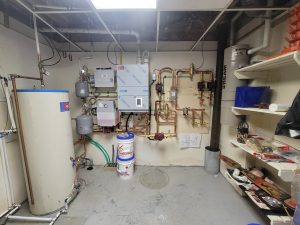
Specifying the wrong boiler panel early in a large commercial project creates expensive problems later: field modifications that void warranties, delayed occupancy, and mechanical rooms that simply do not work the way the engineer intended. For Calgary projects, where heating loads are serious and project timelines are tight, the pre-built versus custom decision deserves careful thought before a single line goes on the drawing set.
- What Are Boiler Panels and Why Do They Matter on Commercial Projects?
- Pre-Built Boiler Panels: The Case for Speed and Predictability
- Custom Boiler Panels: When the Project Demands More
- Key Specification Criteria for Calgary Commercial Projects
- Working with a Hydronic Supplier in Calgary
- Frequently Asked Questions
What Are Boiler Panels and Why Do They Matter on Commercial Projects?
Boiler panels are pre-assembled or custom-built piping assemblies that bring together the primary components of a hydronic heating system: circulators, headers, isolation valves, expansion tanks, air separators, and controls. Rather than fabricating all of that in the mechanical room piece by piece, a panel arrives as a single, tested unit ready to connect to the boiler plant and the distribution system.
On large commercial projects, the panel is the operational heart of the hydronic heating system. It governs flow rates, zoning, temperature control, and system protection. A well-specified panel means the system commissions quickly and performs reliably through decades of Alberta winters. A poorly specified one means field changes, balancing problems, and callbacks.
Calgary’s climate adds weight to that decision. Design temperatures routinely drop below minus 30 degrees Celsius, and commercial buildings here carry substantial heating loads. The panel must be sized and configured to match the boiler plant output and the building’s zone demands, not just selected from a catalogue because the lead time is short.
Pre-Built Boiler Panels: The Case for Speed and Predictability
Pre-built boiler panels are factory-assembled to standard configurations, pressure-tested before they ship, and designed to fit a defined range of boiler sizes and system types. For the right project, they offer real advantages that a custom fabrication cannot match on timeline alone.
The strongest argument for pre-built is speed. A standard panel can ship within days rather than weeks, which matters enormously when a project is running behind or a mechanical contractor is sequencing multiple trades. Factory assembly also reduces field labour, which lowers installation cost and limits the chance of field error during a busy construction schedule.
Pre-built panels work best when the system fits within standard parameters: a defined number of heating zones, a boiler plant in a common size range, and a straightforward control strategy. Projects such as mid-size office buildings, schools, and multi-unit residential blocks often fall into this category. We also offer pre-built pump boards for distribution applications where the same logic applies.
The limitation is configurability. If the project requires an unusual zone count, a non-standard flow rate, or controls integration that the standard assembly does not support, forcing a pre-built panel into that application creates compromises that follow the system for its entire service life.
Custom Boiler Panels: When the Project Demands More
Custom boiler panels are engineered and fabricated to the exact requirements of a specific project. Every component, from header size to circulator selection to control wiring, reflects the actual system design rather than a nearest-standard approximation.
Large commercial projects in Calgary frequently require custom panels. A mixed-use tower with radiant slab, domestic hot water, snow melt, and ventilation preheat all drawing from the same boiler plant needs a panel that manages each load independently while protecting the boilers from low return temperatures and short-cycling. That level of integration is not available off the shelf.
Hospitals, arenas, and district energy plants are other examples where custom fabrication is the only responsible path. These facilities operate continuously, serve critical or comfort-sensitive occupancies, and often carry redundancy requirements that a standard panel cannot accommodate. Our guide to custom boiler panels in Calgary covers the build process in more detail for engineers who want to understand what goes into the specification.
The trade-off is lead time and cost. A custom panel requires engineering, fabrication, and factory testing, which adds weeks to the procurement schedule and dollars to the budget. Specifying early and engaging a supplier during design development rather than at tender closing is the best way to manage both variables.
Key Specification Criteria for Calgary Commercial Projects
Whether the project calls for a pre-built or custom solution, the specification needs to address the same core criteria. Getting these right at the design stage prevents substitution arguments at tender and commissioning surprises after substantial completion.
- Flow rate and pressure drop: Size the primary headers for actual system flow, not the boiler nameplate. Undersized headers create noise, erosion, and balancing problems.
- Zone count and priority sequencing: Identify every load and confirm whether the panel must handle priority switching, such as domestic hot water priority over space heating.
- Low-temperature protection: Alberta’s climate means boilers are often firing at high output. The panel must protect against flue gas condensation on non-condensing boilers through a mixing or bypass arrangement.
- Controls interface: Specify whether the panel integrates with a building automation system and at what signal level. This affects wiring provisions and the control valve selection.
- Pressure rating and testing: Confirm the working pressure matches the system design and require a factory hydrostatic test certificate with the submittal package.
For projects with multiple buildings or campus-scale distribution, the panel specification should also address primary-secondary or variable primary pumping strategies. These decisions affect not just the panel itself but the entire hydronic heating system in Calgary and deserve early coordination between the mechanical engineer and the hydronic supplier.
Working with a Hydronic Supplier in Calgary
The specification process goes better when the hydronic supplier is involved during design development rather than after tender. Suppliers who build both pre-built and custom panels can evaluate the system requirements honestly and recommend the right solution rather than defaulting to whatever is in stock.
Submittals should include dimensional drawings, flow schematics, component schedules, and test certificates. For custom panels, a factory witness test option is worth requesting on large projects. These documents protect the engineer of record, give the mechanical contractor accurate installation information, and give the owner a complete record for future service.
Ongoing service access matters too. A panel that is well-built but impossible to service creates long-term operating costs. Confirm that isolation valves, air vents, and instrument connections are accessible after the panel is installed in the mechanical room. For service needs after commissioning, our team also handles boiler repair in Calgary, and we support similar projects across Alberta through boiler repair in Edmonton.
If your project spans multiple markets, we have resources for comparable decisions in other western Canadian cities. Our post on boiler panels in Vancouver addresses the pre-built case in a milder climate context, and our custom boiler panels in Edmonton guide covers cold-climate custom fabrication in detail.
Ready to specify the right boiler panel for your Calgary commercial project? Contact the Evolve Hydronics team early in the design process. We work directly with mechanical engineers and contractors to evaluate system requirements, produce accurate submittals, and deliver panels that commission cleanly and perform through Alberta’s demanding heating season. Reach out through our contact page and we will get your project on our schedule.
Frequently Asked Questions
How long does it take to receive a custom boiler panel in Calgary?
Lead times for custom boiler panels typically range from four to eight weeks depending on complexity, component availability, and the supplier’s current production schedule. Engaging the supplier during design development rather than at tender gives the project the best chance of receiving the panel on time. Pre-built panels ship much faster, often within five to ten business days for standard configurations.
What boiler sizes do pre-built panels typically support?
Most pre-built panel configurations support boiler plants in the range of 500 MBH to 2,000 MBH, though this varies by manufacturer. Systems outside that range, or those with multiple boilers in a cascade arrangement, generally require a custom assembly to match the actual flow rates and control sequencing the plant demands.
Do boiler panels need to meet specific Alberta codes or standards?
Yes. Boiler panels installed in Alberta must comply with the Alberta Boiler Safety Association (ABSA) requirements, the Alberta Building Code, and CSA B149.1 where gas piping connections are involved. Factory-built panels should carry documentation confirming pressure testing and component ratings that satisfy these requirements. Always confirm compliance with the authority having jurisdiction before installation.
Can a pre-built panel be modified in the field to fit a non-standard application?
Field modifications to a factory-built panel are generally not recommended and can void the manufacturer’s warranty and the pressure test certification. If a pre-built panel does not fit the project requirements without modification, a custom panel is the correct solution. Forcing a standard product into a non-standard application typically costs more in labour and callbacks than specifying custom from the start.
What information does a hydronic supplier need to quote a custom boiler panel?
A supplier needs the system flow schematic, total connected boiler capacity, zone count and flow rates for each zone, supply and return temperature design points, building automation system interface requirements, and the mechanical room dimensions. Providing a complete design brief at the outset allows the supplier to produce an accurate quote and a submittal that requires minimal revision.
Is there a cost difference between pre-built and custom boiler panels?
Pre-built panels carry a lower upfront cost for standard applications because they benefit from volume manufacturing and stock components. Custom panels cost more to engineer and fabricate but eliminate the field labour and commissioning time that a mis-matched standard panel requires. For large commercial projects, the total installed cost, not the panel price alone, is the right number to compare.